
Definition and Purpose of Sun Blocking Chemicals
Sun blocking chemicals refer to a diverse range of compounds formulated to safeguard our delicate skin from the harmful effects of UV radiation.
These compounds primarily function in two ways: either by absorbing or reflecting solar energy before it reaches our skin.
The first category comprises organic or chemical filters, such as avobenzone, oxybenzone, and octinoxate. These substances are adept at absorbing UV rays and transforming them into less destructive energy forms, thereby diminishing their impact on our skin cells.
The second category consists of inorganic or physical filters like zinc oxide and titanium dioxide. These minerals act as a physical barrier on the skin’s surface by reflecting and scattering UV rays away from our bodies.
Overview of Chemical and Mineral Sunscreen Ingredients
Organic (Chemical) Filters
Absorbing UV Rays for Enhanced Protection
Organic sun blocking chemicals, commonly referred to as chemical filters, constitute a significant category of ingredients used in sunscreens. These compounds, such as avobenzone, oxybenzone, and octinoxate, work by absorbing ultraviolet (UV) rays and converting them into less harmful energy.
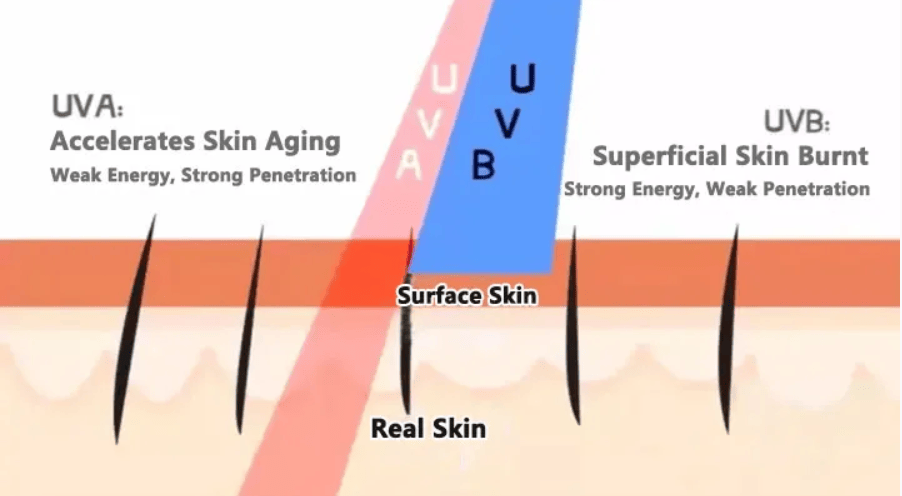
UVA and UVB
Avobenzone is a well-known organic filter that effectively absorbs both UVA and UVB rays.
Its development was a significant breakthrough in broad-spectrum protection against the damaging effects of the sun. However, one challenge associated with avobenzone is its photostability issue.
When exposed to sunlight, it can degrade rapidly and lose its effectiveness over time. To counteract this problem, sunscreen manufacturers often combine avobenzone with stabilizing ingredients like irgacure 819 or other UV absorbers that help maintain its efficacy.
Oxybenzone is another common organic filter that provides excellent UVA and UVB protection.
Inorganic (Physical) Filters
Reflecting and Scattering UV Rays for Shielding the Skin
Inorganic filters are generally referred to as physical filters because they act by reflecting and scattering UV rays away from the skin’s surface without undergoing chemical changes. Examples of inorganic filters commonly found in sunscreens are zinc oxide and titanium dioxide.
Zinc oxide, a naturally occurring mineral, has been used for centuries as a topical application to protect the skin from burns and irritations.
In sunscreen formulations, it forms a protective barrier on the skin’s surface that effectively blocks both UVA and UVB rays. The main advantage of zinc oxide is its inherent broad-spectrum protection and stability under sunlight exposure. Additionally, it is considered safer for sensitive skin due to its lower risk of irritation compared to certain chemical sunscreen ingredients.
Titanium dioxide is another physical filter widely employed in sunscreens due to its high refractive index.
what is the difference between chemical and mineral sunscreen ingredients
While organic filters absorb UV rays, converting them into less harmful energy within the skin, inorganic filters act by reflecting and scattering UV rays away from the surface
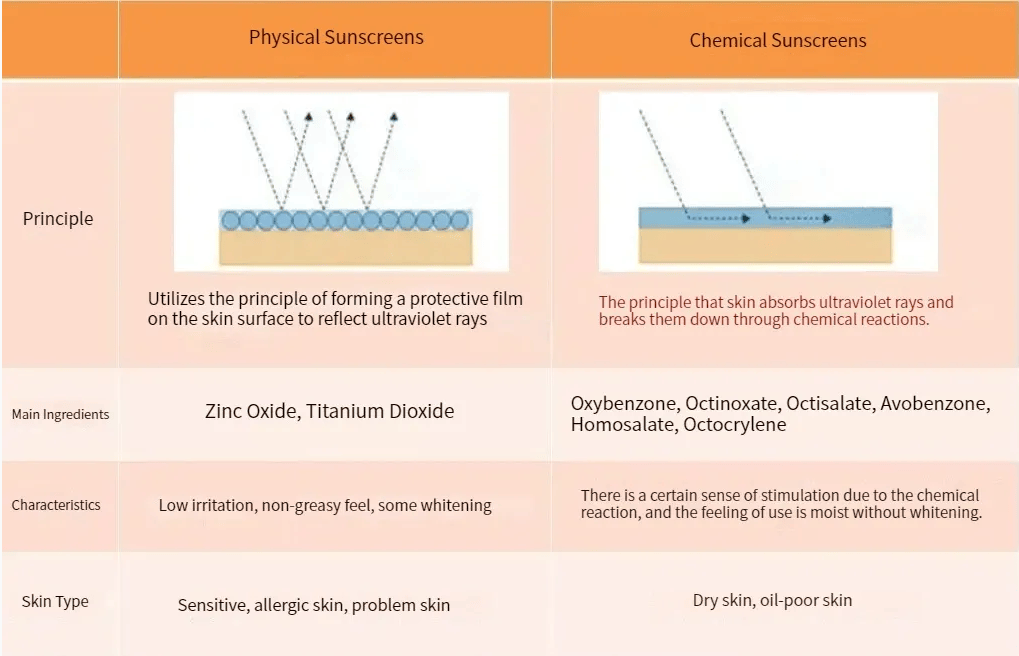
Physical Sunscreens VS Chemical Sunscreens
Mineral sunscreens use natural minerals like zinc oxide and titanium dioxide to create a physical barrier on the skin that reflects UV light.
Chemical sunscreens use synthetic chemicals like oxybenzone, avobenzone, octisalate, octocrylene, homosalate, and octinoxate to absorb and neutralize the heat generated by UV rays from the skin.
Mineral sunscreens are generally considered to be gentler and less likely to cause skin irritation, making them a good option for people with sensitive skin. It’s important to note that both mineral and chemical sunscreens are regulated by the FDA for safety and effectiveness.
Protecting the Skin from Harmful UV Radiation
By incorporating these compounds into sunscreen formulations, we are not only able to prevent sunburns and premature aging but also reduce the risk of developing skin cancer. Know that sun protection is a year-round necessity, as UV radiation can penetrate through clouds and reach our skin even on cloudy or cooler days.
Pros and Cons of Chemical and Mineral Sunscreens
Here is a table summarizing the pros and cons of chemical and mineral sunscreens
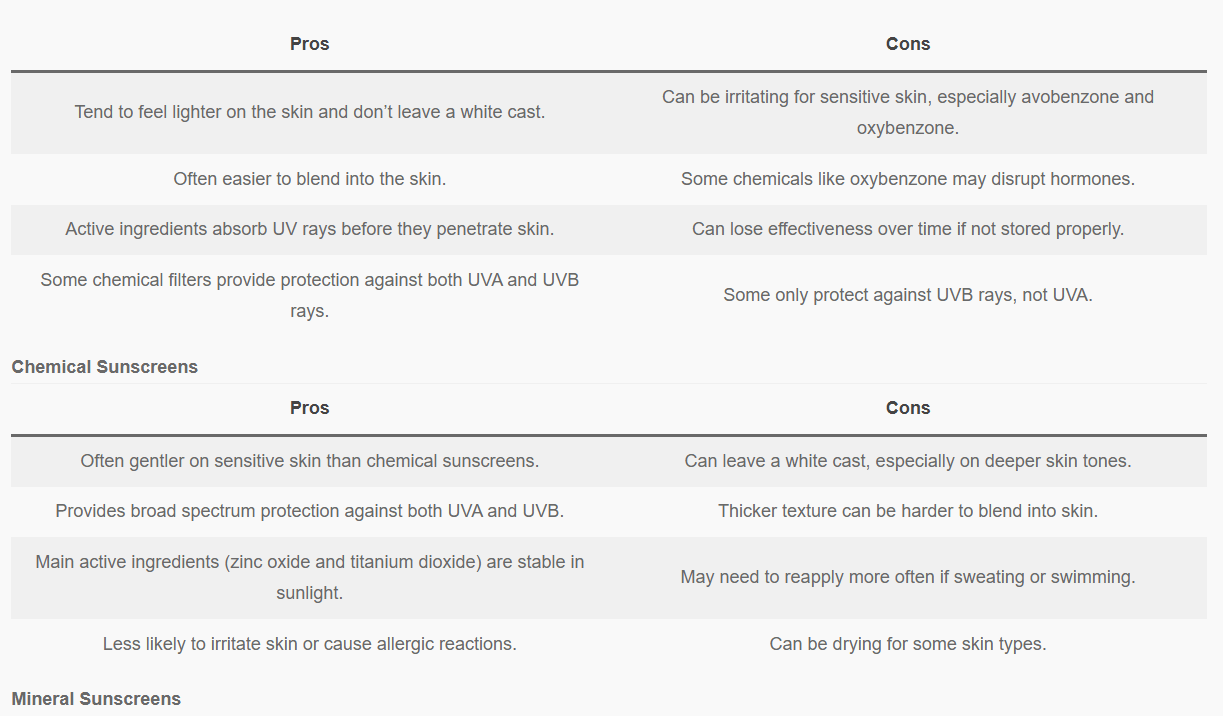
Suitability of sunscreen for different skin types
For normal/oily skin, chemical sunscreens tend to work well and blend in easily. For dry or sensitive skin, mineral formulas are often a better choice. Those with acne-prone skin may want to avoid chemical sunscreens with oils. For deeper skin tones, tinted mineral sunscreens help avoid white cast issues.